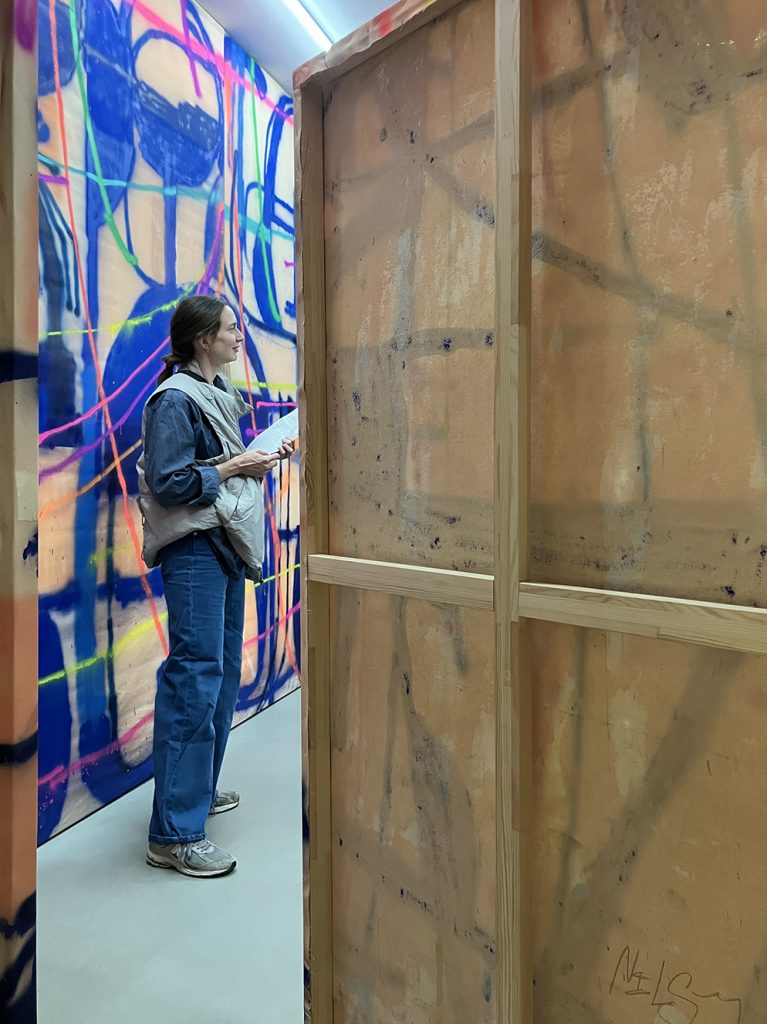
“All the same, it is in the studio and only in the studio that it [the art work] is closest to its own reality, a reality from which it will continue to distance itself. (…) It is therefore only in the studio that the work may be said to belong.“
– Daniel Buren: The Function of the Studio (1979)
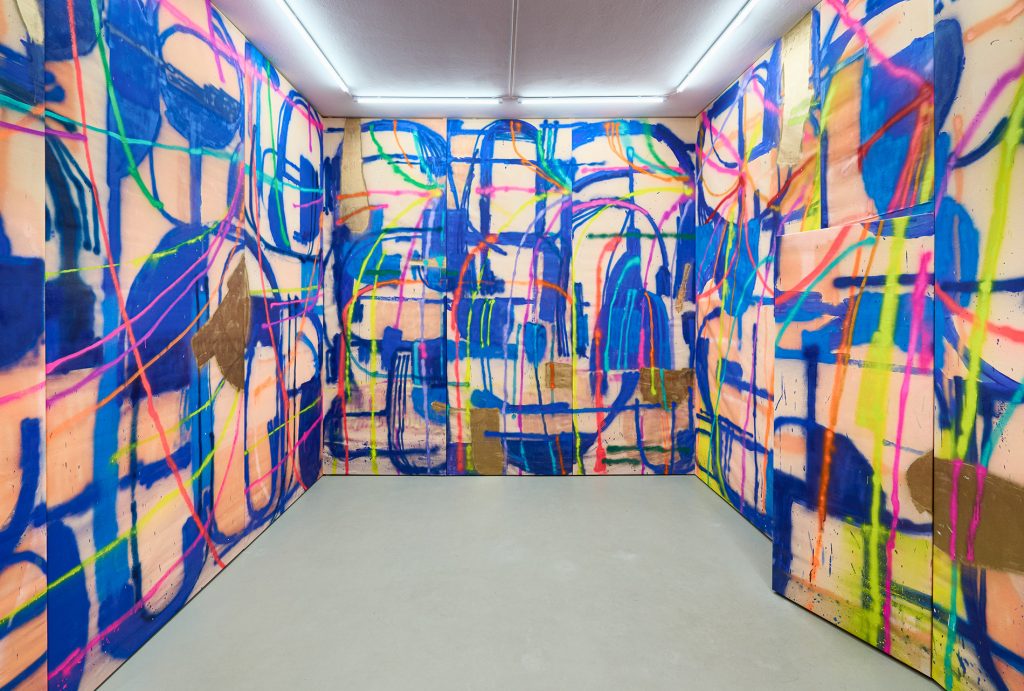
For the show Running for Paint, the gimp invited Freiburg-based artist Nils Jendri to paint the biggest painting on canvas he has created to date. In the artist’s painterly expression, we are inevitably confronted with an immense urge to paint. This urge is given maximum space to unfold, exhausting dimensions and colorfulness on custom-made canvas frames provided by the gimp for the site-specific work.
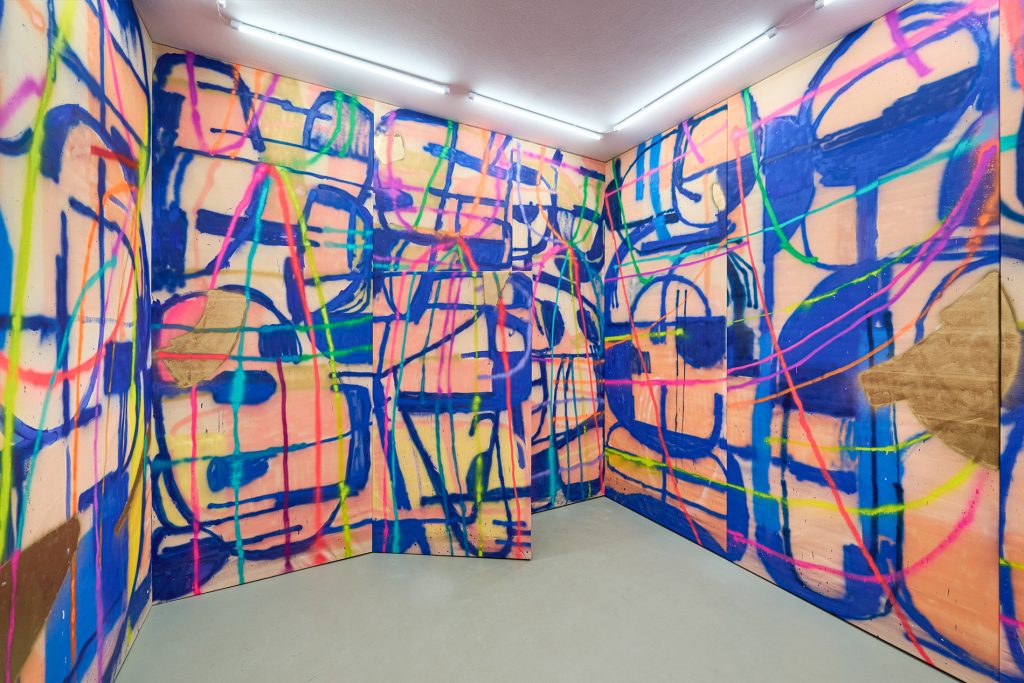
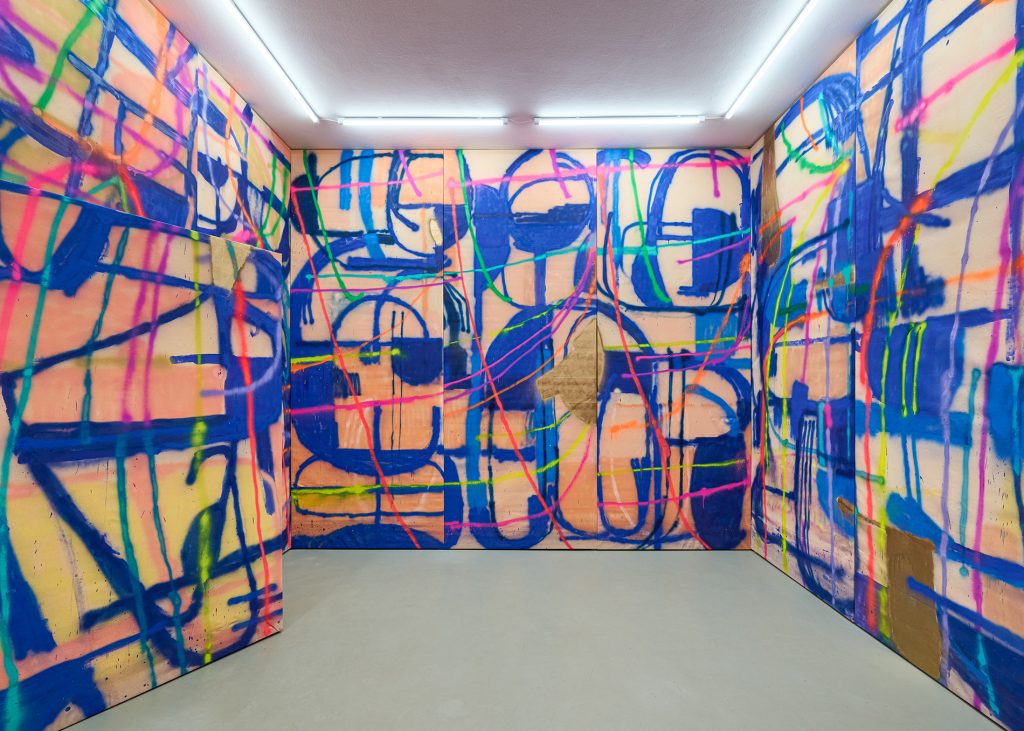
In the spirit of “alles was geht”—we see as much paint and painting as one can possibly fit into the 12 sq m room: Jendri conceived the entire room as one painting, which can never be seen in its entirety from a single viewpoint. Despite painting one wall per day, he maintains visual coherence across all four walls. We ended up with so much paint(ing) that there is no longer a wall, but a tapestry-like lining, dense with paint and a diversity of colours, irregular patterns, yet overall balanced throughout an ongoing drive, ignoring the offsets between the single frames. The painting spans over 14 frames, as it was split up into pieces simply for pragmatic reasons. The total image size is defined by the scale of the room, not by the artist’s studio as the work’s site of production, but its site of display. Commonly, artworks are created to then be viewed in another space and thereby stripped of their original context: the spatial conditions they were created in. The conditions of the studio that influence the process of creation, not only pragmatically, can no longer be taken into account when contemplating the work: Jendri painted this work in a studio space too small to fit the canvas in its height—but these conditions become visibly evident in the painting itself. Jendri painted a wall a day, continuing clockwise, with one to two days’ breaks for priming the canvas. It was only when setting up the exhibition at the gimp that all four walls came together to form the whole work.
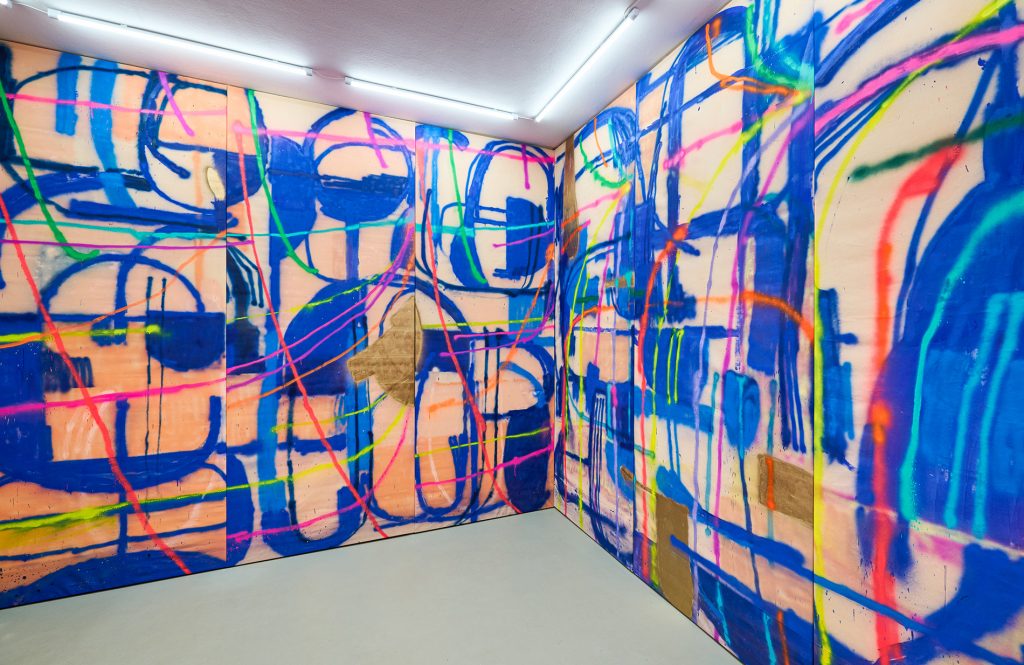
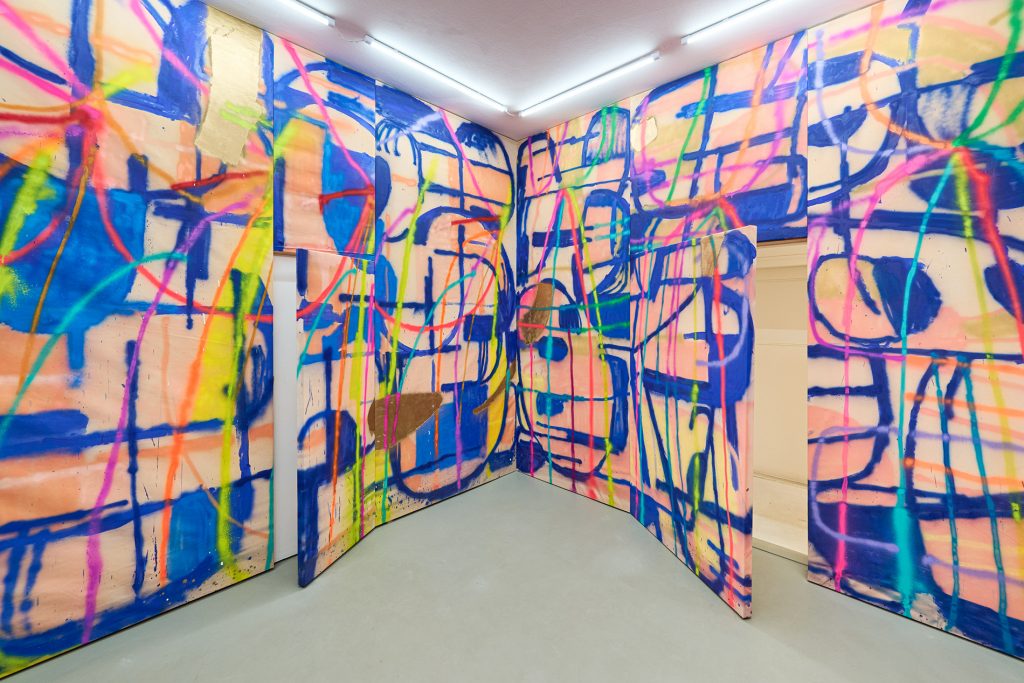
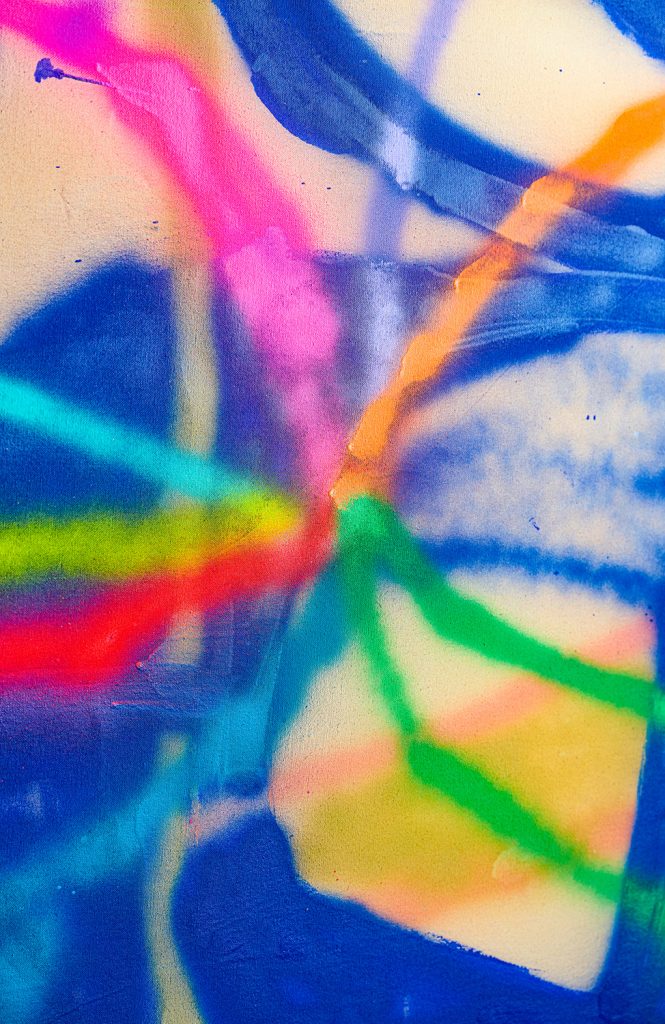
When trying to figure out the temporal order in which the layers of color or lines were painted— which color was first, then painted over by another—you end up getting lost in a labyrinth of paint, as it is nearly impossible to say what came first and what came after: some parts fade as if hidden behind a matted pane of glass – background suddenly becomes foreground – lines of different colors reach into each other, and different hues of blue form one shape.
Now that the room lacks its white walls, it appears different, once again: no traces of windows, no visible doors, just a narrow slit in the canvas. We find ourselves trapped in strange acoustics and confronted with an unusual proportion between room size and artwork size. How would our perception of the work change when it is viewed as a painting in the way we are familiar with: flat and surrounded by white walls?
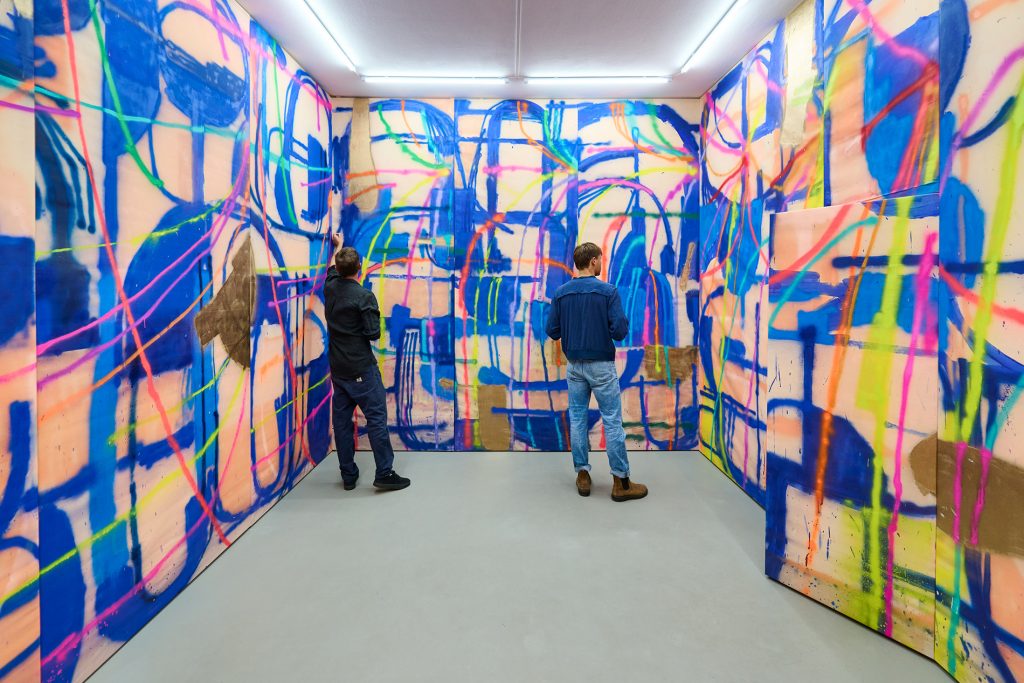
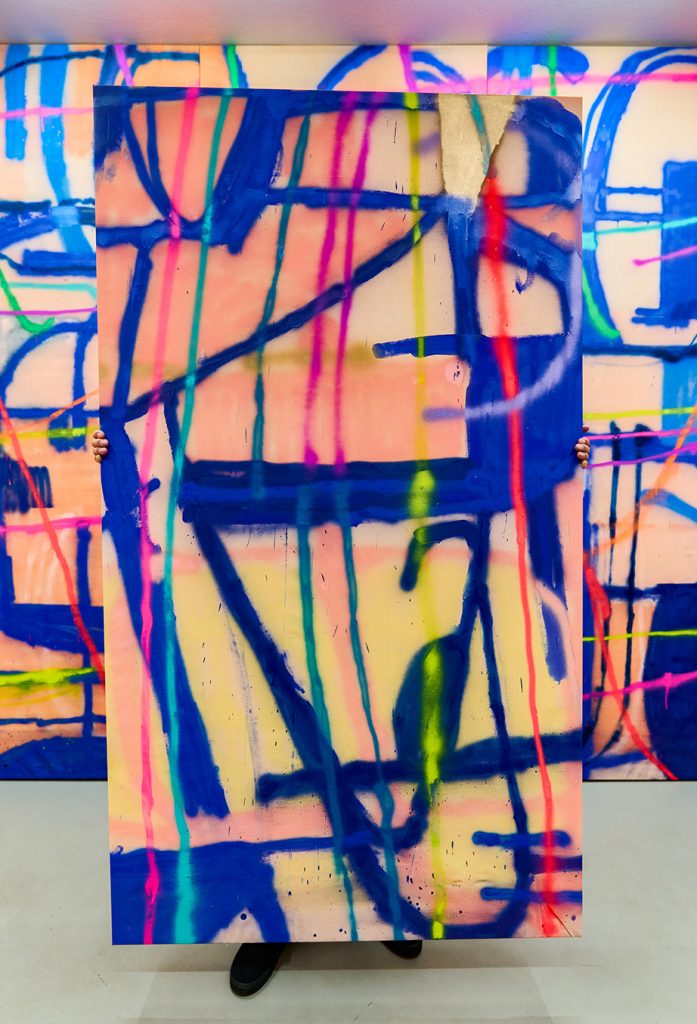
One day, imagine, if we unfold this painted room and turn it back into two dimensions, we would stand in front of a 14-meter-long painting. But where to start and where to end? Which part would be the left edge of the painting? Where would the room be cut up? Where to start and where to end in the painting process itself? The urge to paint, paused, interrupted only by the end of the day or the lack of space in the artist’s studio.
text: Isabell Alexandra Meldner
photos: Nils Bornemann, Friedrich Herz